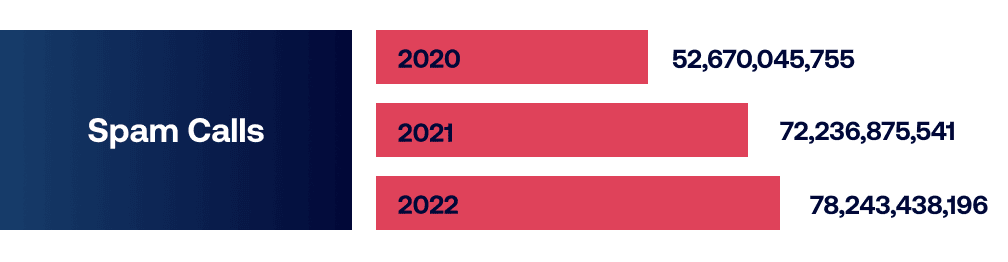
Americans received over 78 billion spam calls in 2022, marking a 43% increase from 2020. Even worse, consumers lost an estimated $65+ billion in the process — more than double the year before.
Spam has infiltrated our cell phones, and it's making itself at home. Agencies like the Federal Trade Commission (FTC) and Federal Communications Commission (FCC) are working on a comprehensive solution, but in the meantime, it's important to know what a spam call is and how you can handle it.
Here's everything you need to know about how to recognize and block unwanted spam calls, protect your personal information, and fight back against scammers.
What is a spam call?
We use the term "spam call" to refer to unwanted and unsolicited phone calls that try to get something of value out of the target. Spam calls generally include sales pitches or attempt to distill personal information. All spam calls can be annoying, but some can also be dangerous.
How spam calls affect you
Spam calls aren't just irritating, but often lead to severe consequences like compromised online accounts, financial losses, and even identity theft. If a scammer gets hold of the right information, they can take control of your:
- Bank accounts
- Credit cards
- Online shopping accounts
- Social Security Number
- Identity
Once the damage has been done, it may be impossible to reverse. That's why it's critical to understand how to spot and protect yourself from dangerous spam calls.
Types of spam calls
As technology evolves, so do spammers' techniques. Spam calls come in several different forms, and it pays to recognize not only what a spam call is, but which ones you should worry about.
Telemarketing calls
Although annoying, legitimate telemarketing calls are legal — unless you're on the National Do Not Call Registry. If you've registered your number, telemarketers are not allowed to call you and face steep penalties if they do. These penalties don't do much to deter overseas scammers, however, so the Registry won't protect you from them.
Robocalls
A robocall is an automated call that uses a pre-recorded message. Legal robocalls are often useful, like appointment reminders or school-closing announcements, but the majority of them are illegal. Robocalls are illegal when they try to sell you something, solicit information, or contact you without your written consent.
What is a robocall?
A robocall is any call you pick up or receive a voice message from — whether on a landline, a mobile phone, or a connected personal device — where you hear a recorded message instead of a live person.
Scam calls
Spam calls that seek to defraud people by stealing personal or financial information are scam calls. This type of spam call is the most dangerous and is always illegal.
IRS scams
Getting an unexpected call from a government agency can be shocking, which is the idea behind IRS scams. Scammers may pose as the IRS, calling to collect a debt and hoping you'll be eager to pay the balance. In reality, the IRS won't call you unless you owe money and have been ignoring the letters they've sent through the mail.
AI scams
Artificial intelligence has recently become more accessible, and scammers have wasted no time using it to their advantage. AI scams can be especially scary because of voice cloning, in which scammers use convincing replicas of people's voices to target their friends and family for information or cash. If you get a call that sounds like a loved one in trouble, call that person and the police.
Charity scams
Some scammers pose as charities for veterans, cancer research, or other noble causes that people would be glad to support. Unfortunately, these donations — and your information — go right into the pockets of criminals. Do your research before donating to an unfamiliar charity, and never give out your payment details over the phone.
Travel scams
People were eager to travel again after the stir-craziness of the COVID-19 lockdown, and scammers took the opportunity to target people with fake vacation packages. Discounted rates seemed logical coming out of an extended pause in the industry, but these scams continue to be too good to be true. If you're offered a deal on a trip, be cautious and do your research to verify its authenticity.
Loan scams
Student loans are a source of confusion and distress for a generation of borrowers who struggle to make payments, making them low-hanging fruit for scammers who prey on the vulnerable. Student loan scams have been historically popular for this reason, but scammers offer people fake solutions to all types of debt. Beware of random offers that sound too good to be true.
Tech support scams
We depend on our devices for just about everything, so we act quickly when something goes awry. Tech support scams exploit that vulnerability by alerting you to a security breach, technical malfunction, or other fake issue that might require a change of password or even remote control of your device. Real tech support generally doesn't call you. It's you who calls them if you have a problem.
Free trial scams
A free trial is a good way to find out if you're interested in a product or service, but not if it puts your sensitive information on the line. You might get a call offering an unbelievable product and a free trial or sample to make sure you like it — you just have to pay for shipping and handling. However, there may be fine print that signs you up for monthly shipments or requires you to return the product within a week to avoid a charge. In other cases, the scammer might sell your credit card information.
Health insurance scams
Some health insurance scams offer low rates on plans and discounts for club memberships, while others impersonate real insurance providers like Medicare and try to collect renewal fees. It's crucial to be familiar with your health insurance plan and recognize when scammers pitch a fake offer.
Google impersonator scams
Certain scam calls are more specific to businesses, like calls from Google representative impersonators claiming that your company's page is about to be removed from the search engine or Google Maps. If you get a call like this that asks for sensitive information, hang up and contact Google at a verifiable number.
Eliminate 99% of spam calls with Robokiller
Learn moreSpoofed calls
Spammers use a tactic called Caller ID spoofing to make their phone numbers look similar to yours or come up as a legitimate company. The goal is to earn your trust by looking familiar, making you more likely to pick up the phone. Caller ID spoofing is one of the biggest hurdles to blocking spam because the technology is cheap and difficult to trace.
Identifying spam calls
Knowing how to spot a spam call can be a lifesaver, and the signs are usually clear. Commit the warning signs to memory and you may be able to spot a scammer before they can do any damage.
Common signs of spam calls
Asking for personal information: Spammers value all sorts of personal details, from email addresses and usernames to bank account and credit card information.
Robocalls: Companies can't robocall you without prior written consent, but spammers do so regularly.
Sense of urgency: Spammers want you to act before you can think, so they'll often make it seem like there's a pressing issue or a time-sensitive reward.
Unfamiliar number (or the opposite): If you get an unexpected call from an unknown number, there's always a chance it's spam. However, a familiar number that's been spoofed could mean the same thing.
Pro tip
A key distinction between legitimate and illegitimate robocalls is the presence of a sales pitch. When the caller tries to sell you something, chances are it's a scam.
Phone number lookup
Some spam-blocking services, like Robokiller, offer a free lookup tool that allows you to type in a phone number and determine if it's associated with spam.
What happens if you answer a spam call?
Though it can be tempting to pick up and give the caller a piece of your mind, it's always best to ignore spam calls. Answering the phone shows the scammer that they've found an active number and may lead to even more calls in the future.
Managing and blocking spam calls
Spam and scams are a serious threat to our privacy and security, but steps are being taken to crack down on them. Recent years have seen an uptick in new spam-fighting legislation and initiatives:
TRACED Act (2019): Gives the FCC greater ability to fight spam and enforce anti-spam laws
STIR/SHAKEN (2020): Requires phone carriers to implement robocall mitigation plans and authenticate caller ID information to reduce spoofing
Project Point of No Entry (2023): Restricts gateway providers from routing illegal traffic through other networks, helping to block spam calls that originate from overseas
Built-in features in smartphones
Most cell phones have built-in features that can help you cut down on unwanted calls. Android and iPhone users have the ability to block contacts directly from their phones, and they can also block calls from anyone outside their contacts lists.
Download a spam blocker app
The most effective move you can make in the fight against spam is to find the best spam blocker app for you. The FTC recommends reliable spam-blocking apps like Robokiller, which use call data and reports from users, the FTC, and other sources to determine which calls are illegal or likely scams.
Spam call blocking: How it works
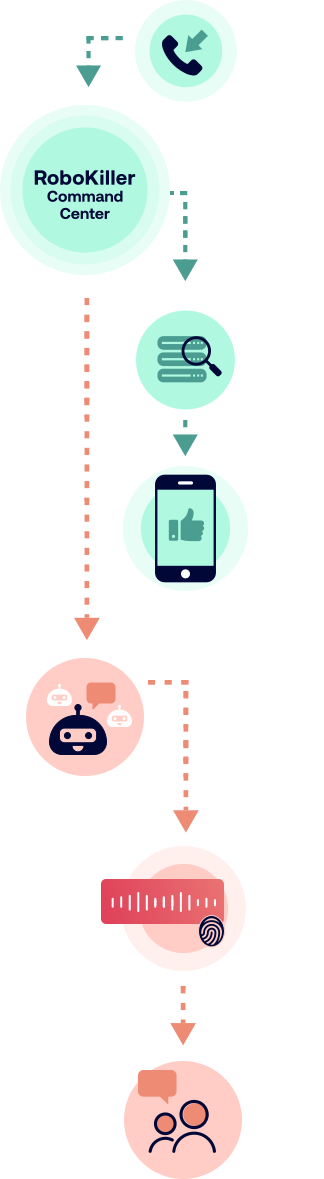
A spammer places an incoming call to you, and Robokiller intercepts it.
We check our massive database of phone scam callers for any record of the number.
If recognized as a known scammer, we block the call so it never reaches you.
If there's no record, we analyze the metadata of the phone call to determine if it's likely spam.
If the call seems safe and you've enabled call screening, Robokiller will screen the call and ask the caller to identify themselves.
When a call is recognized as spam, our Answer Bots waste the scammer's time and we create an audio fingerprint stored in our global database.
How does Robokiller fight spam calls?
Call blocking algorithm
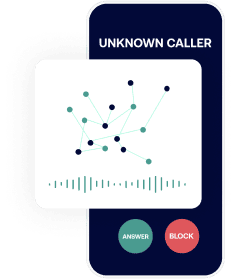
Robokiller uses a predictive spam call-blocking algorithm that analyzes incoming calls and identifies whether they're spam in less than a millisecond — well before they can ring your phone.
See how it works →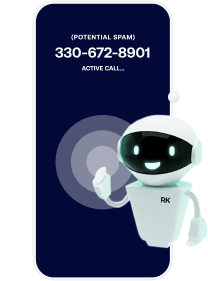
Answer Bots
Get spam call revenge with the help of our Answer Bots — hilarious spam-call-fighting bots that turn the tables on spam callers and waste their time.
Listen to RoboRadio →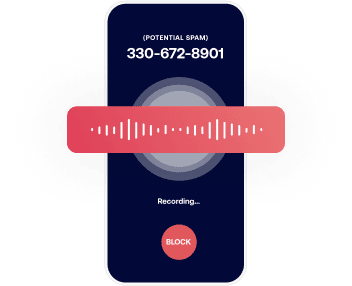
Audio fingerprinting
Our patented audio-fingerprinting technology creates a record of a spam caller's unique audio recording and checks it against our global database in real-time.
Silence unknown callers
For extra protection, you can strengthen the blocking features on your personal and work devices. Here's how to enable this setting on iPhone:
- Go to Settings
- Scroll down and tap Phone
- Scroll down again and tap Silence Unknown Callers
- Toggle on Silence Unknown Callers
And here's how it works on Android devices:
- Open the Phone app
- Tap the three dots
- Tap Settings
- Tap Blocked numbers
- Toggle on Unknown
Note:This function will silence all unknown calls, so if you're expecting an important call from outside your address book — like from a doctor, school, or mechanic — you may miss it.
Add yourself to the Do Not Call Registry
Consumers can also add their phone numbers to the National Do Not Call Registry at no cost. Keep in mind, spam callers aren't known for abiding by the law, so this tactic is often futile as a standalone measure.
Report spam calls to authorities
You can help take down scammers and protect the community by reporting spam calls to the authorities:
Block the caller and report the call as spam through your phone
Call or email your phone carrier to report suspicious calls
Report spam online at FTC (reportfraud.ftc.gov) or FCC (fcc.gov/complaints)
Report unwanted calls to the National Do Not Call Registry (donotcall.gov/report)
Learn about Robokiller's award-winning features
Explore nowTry Robokiller for free for 7 days
Get robocall revenge™ with Robokiller
Spam calls may not be new, but they're anything but retro. Not only are the bulk of spam calls annoying and illegal, they can also lead to fraud, financial loss, and identity theft. While we can't eradicate scam calls overnight, we can take back our privacy. Spam-call blocker and robocall-revenge app Robokiller is here to support you with the tools you need to fight spam callers.
Spam call FAQs
Why am I getting spam calls?
Getting spam calls means your number fell into the wrong hands. Although some types of spam calls are technically legal, many are designed to steal personal information like usernames, passwords, and bank account numbers.
How are spam callers getting my number?
There are many ways spammers can find your phone number. It may have been exposed in a data breach, given away when signing up for a free trial or mailing list, or simply dialed at random via autodialing technology.
How can I report a spam call to the authorities?
You can report a spam call by visiting the FTC (reportfraud.ftc.gov) or FCC (fcc.gov/complaints) online, filing a report with the National Do Not Call Registry, or notifying your phone carrier about the incident.
Can spam calls be dangerous or lead to identity theft?
Yes. Spam calls target personal information that scammers can use to access people's finances, which they can use to drain accounts, open up new lines of credit, and take over identities.
What do I do if I receive a spam call?
The simplest way to handle a spam call is to hang up. If the call claimed to be from a business, call back at a publicly listed number and ask if they tried to contact you. If they didn't, you can both report the spam.